
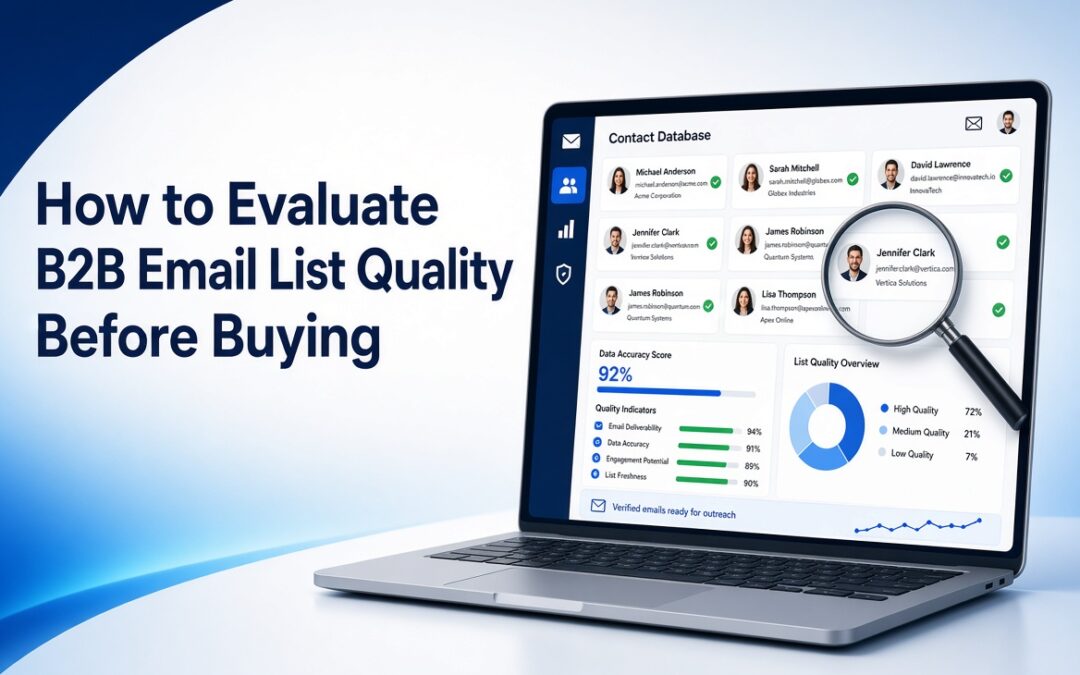
Buying a business contact database can help companies reach potential customers, generate leads, and improve their B2B marketing campaigns. However, purchasing a large database does not automatically guarantee better results. B2B email list quality plays a significant role in determining whether your campaigns reach relevant decision-makers and generate meaningful engagement.
Before investing in a contact list, businesses should evaluate its accuracy, relevance, verification process, and compliance standards. This guide explains how to assess a B2B email list before buying and make a more informed purchasing decision.
1. Check Email Address Accuracy
Email accuracy is one of the most important indicators of B2B email list quality. Incorrect, outdated, or inactive addresses can increase bounce rates and negatively affect your sender reputation.
Ask the provider how frequently its database is updated and what methods it uses to verify email addresses. Reliable providers should explain their validation process and clarify what their verification results mean.
Look for information about:
-
Valid and deliverable business email addresses
-
Detection of invalid or malformed addresses
-
Identification of duplicate contacts
-
Removal of known inactive or outdated records
Remember that email verification cannot guarantee delivery or engagement. Even a recently verified address may become inactive or reject incoming messages.
2. Evaluate Contact Relevance
A high-quality B2B email list should match your ideal customer profile. A large database has limited value if it contains contacts who are unlikely to need your products or services.
Before purchasing, identify the industries, company sizes, locations, and professional roles you want to target.
For example, a company selling HR management software may prioritize HR directors, human resources managers, and talent acquisition leaders rather than unrelated employees.
Check whether the provider allows filtering by:
-
Industry and business category
-
Job title and department
-
Seniority and decision-making authority
-
Company size and annual revenue, where available
-
Country, state, or business location
Precise targeting helps businesses focus their resources on relevant prospects instead of sending generic messages to a broad audience.
3. Review Data Freshness
Business contact information changes frequently. Employees change jobs, companies restructure, and professional email addresses become inactive. An outdated database can therefore reduce campaign effectiveness.
Ask when the contacts were last reviewed or verified. Find out whether the provider regularly updates job titles, company details, and email addresses.
A useful B2B database should contain clear information about its update frequency and data collection methods. Be cautious of providers that cannot explain when their records were collected or refreshed.
Prioritize recent, relevant information over a database that simply advertises millions of contacts.
4. Request a Sample List
Requesting a sample is a practical way to assess a provider before committing to a large purchase. A sample allows you to examine the format, completeness, and relevance of the records.
Review whether the sample includes the fields you need, such as:
-
Business email address
-
Contact name and job title
-
Company name and website
-
Industry classification
-
Business location
-
Available company or professional information
Check a selection of records independently and verify whether the contacts match your target audience. Ask whether the sample is representative of the database you intend to purchase.
Avoid relying exclusively on promotional claims or a small set of handpicked examples.
5. Understand the Verification Process
Not all email verification services use the same methods. Some check formatting and domain records, while others use additional technical checks to estimate whether an address can receive messages.
Ask the provider which verification methods it uses, how recently the addresses were checked, and whether it identifies risky or uncertain addresses.
Pay particular attention to catch-all domains, which may accept messages for multiple addresses without confirming whether a specific mailbox exists. Such records can be difficult to classify accurately.
A transparent provider should explain its verification limitations rather than promise a 100% delivery rate.
6. Check Data Completeness and Consistency
Complete contact records help marketing and sales teams personalize messages and organize campaigns. Missing job titles, inconsistent company names, or incomplete industry information can make segmentation difficult.
Evaluate the percentage of records containing the fields your campaign requires. Check for duplicate contacts, inconsistent formatting, missing company information, and outdated professional details.
If you plan to import the database into a customer relationship management (CRM) system, confirm that the file format is compatible with your platform.
Well-organized data reduces manual cleanup and makes it easier to measure campaign performance.
7. Assess Compliance and Data Sources
Data quality also involves understanding how contact information was obtained and whether it can be used for your intended purpose.
Ask providers about their data sources, collection practices, permissions, and procedures for handling objections or opt-out requests. Review applicable privacy and electronic marketing laws, including the CAN-SPAM Act in the United States and relevant requirements under the GDPR where applicable.
Purchasing a contact list does not automatically establish permission to email every person on it. Businesses should assess their legal basis, follow applicable marketing rules, identify themselves accurately, and honor unsubscribe requests.
Avoid providers that cannot explain their sourcing practices or offer reasonable transparency about data use.
8. Compare Pricing, Guarantees, and Support
Price alone is not a reliable indicator of quality. A low-cost list may require extensive cleaning, while an expensive database may still contain irrelevant or outdated contacts.
Compare providers based on verification standards, targeting options, update frequency, customer support, and replacement policies for invalid records.
Ask whether the provider offers a refund, replacement, or other remedy if the delivered data fails to meet agreed quality standards. Review the terms carefully before purchasing.
Where possible, start with a smaller list and evaluate its usefulness before expanding your investment.
Conclusion
Evaluating B2B email list quality before buying helps businesses avoid unnecessary costs and build more focused marketing campaigns. By checking email accuracy, contact relevance, data freshness, verification methods, completeness, and compliance, companies can make better-informed purchasing decisions.
Request a sample, investigate the provider’s data practices, and confirm that the database matches your ideal customer profile. A carefully evaluated B2B email list can support targeted outreach, improve prospect research, and help sales and marketing teams build more relevant business relationships.