
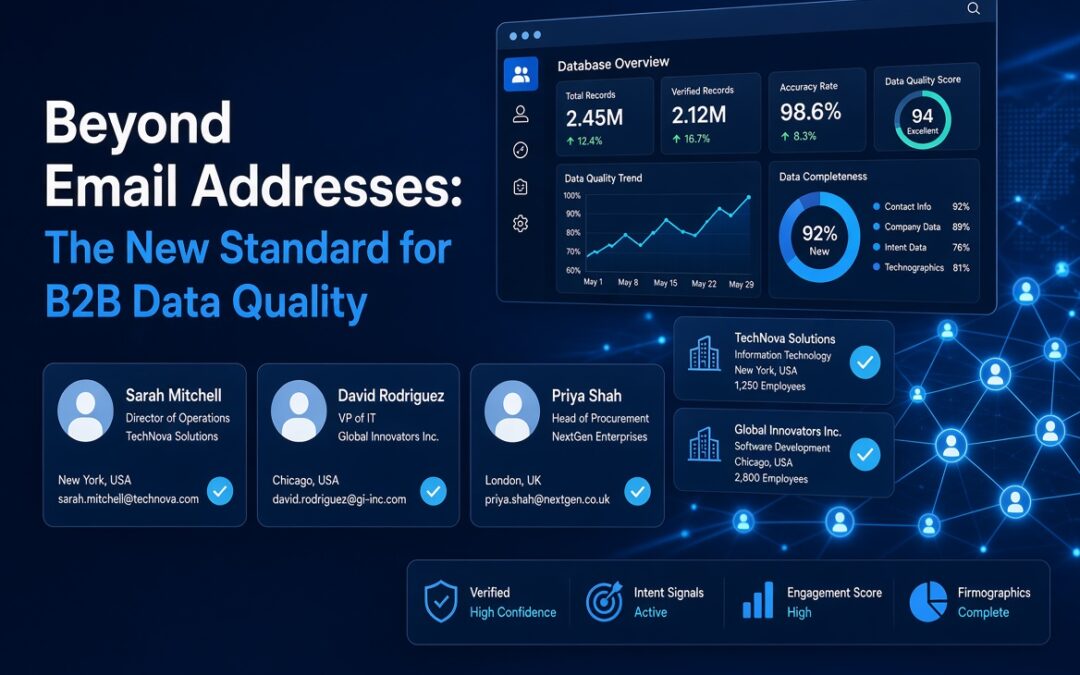
In today’s competitive business environment, having a large collection of email addresses is no longer enough to support successful marketing and sales activities. Businesses need reliable, detailed, and relevant information to understand potential customers and create meaningful connections. This shift has introduced a broader approach to B2B data quality, where accuracy, completeness, relevance, and usability matter as much as contact information.
A high-quality business database should help organizations identify the right prospects, understand their professional needs, and make informed decisions. Moving beyond basic email addresses allows companies to improve targeting, strengthen communication, and build more effective B2B relationships.
1. Why Email Addresses Alone Are Not Enough
An email address provides a communication channel, but it does not explain whether a contact is suitable for a particular campaign. Without additional information, marketing teams may struggle to identify the person’s job responsibilities, company background, or purchasing influence.
For example, a software provider targeting financial institutions needs more than a list of email addresses. It may need information about each contact’s department, seniority, organization size, and business requirements.
When these details are missing, businesses risk sending irrelevant messages, wasting marketing resources, and overlooking valuable prospects. A complete contact profile provides the context needed for more focused outreach.
2. Accurate and Updated Contact Information
Accuracy is one of the most important elements of a dependable B2B database. Incorrect job titles, outdated company details, duplicate records, and inactive email addresses can reduce campaign effectiveness.
Business information changes regularly. Professionals move between organizations, receive promotions, change responsibilities, or leave their positions. Companies may also relocate, expand, merge, or introduce new services.
To maintain reliable records, organizations should review and update their databases regularly. Email verification, duplicate removal, company research, and contact validation can help identify information that requires correction.
An updated database gives sales and marketing teams a stronger foundation for their activities.
3. Complete Company and Professional Profiles
Modern B2B data should provide a broader picture of both individual contacts and the organizations they represent. Instead of relying on a single email field, businesses should consider collecting relevant professional and company attributes.
Useful data points may include:
-
Full name and professional email address
-
Job title and department
-
Seniority level and decision-making role
-
Company name and website
-
Industry and business category
-
Company size and location
-
Relevant business contact information
These details help organizations understand their target audience and identify prospects who match their ideal customer profile.
However, businesses should collect only information that serves a legitimate business purpose and can be handled responsibly.
4. Better Segmentation for Relevant Marketing
A large database becomes more valuable when contacts can be organized into meaningful groups. Segmentation allows businesses to create focused campaigns based on industry, job function, company size, location, or other relevant characteristics.
For instance, a marketing technology provider could create separate audience segments for marketing managers, sales directors, and business development executives. Each group may have different priorities, making tailored communication more useful.
Effective segmentation can help businesses:
-
Deliver industry-specific messages.
-
Identify relevant decision-makers.
-
Reduce unnecessary outreach.
-
Improve campaign organization.
-
Support account-based marketing strategies.
The goal is not simply to divide a database into smaller lists. It is to understand the differences between audience groups and communicate accordingly.
5. Data Consistency Across Business Systems
B2B data quality also depends on how information is organized and maintained across different business platforms. When CRM systems, marketing tools, and sales databases contain inconsistent records, teams may work with conflicting information.
For example, one system might identify a contact as a marketing director while another contains an outdated job title. Such inconsistencies can affect reporting, lead assignment, and communication.
Organizations should establish consistent data-entry standards, field formats, naming conventions, and update procedures. Integrating systems carefully and conducting periodic database audits can also help maintain consistency.
A well-organized database makes information easier to access, interpret, and use across departments.
6. Data Relevance and Business Context
Not every accurate contact is necessarily a valuable prospect. Relevance determines whether the available information supports a company’s sales and marketing objectives.
A database designed for a particular campaign should reflect its target market. For example, a cybersecurity company may prioritize IT directors, information security managers, and technology executives at organizations with suitable business requirements.
Understanding industry, professional responsibilities, company characteristics, and potential business needs helps teams prioritize suitable contacts.
This approach shifts the focus from collecting the highest possible number of records to maintaining information that supports meaningful business opportunities.
7. Responsible Data Collection and Compliance
Reliable B2B information must also be collected and used responsibly. Businesses should understand where their data comes from, whether the collection and intended use are lawful, and what privacy requirements apply to their target markets.
Regulations such as the General Data Protection Regulation (GDPR) and the CAN-SPAM Act establish important requirements for handling personal information and commercial email communications.
Organizations should review data sources, maintain appropriate records, respect applicable consent and opt-out requirements, and provide clear unsubscribe options where required. Purchasing a contact database does not automatically provide permission to send every type of marketing communication.
Responsible data practices help reduce compliance risks and support professional relationships.
8. Measuring and Maintaining B2B Data Quality
Data quality should be treated as an ongoing responsibility rather than a one-time database cleanup exercise. Businesses can monitor several indicators to understand whether their information remains useful.
Important measurements include email bounce rates, duplicate records, missing fields, outdated contact details, verification results, and the percentage of records matching the ideal customer profile.
Campaign metrics such as replies, clicks, and qualified conversions can provide additional insight into audience relevance. However, these results should be considered alongside data accuracy rather than used as its replacement.
Regular reviews and clearly assigned data-management responsibilities help organizations maintain dependable records as their markets evolve.
Conclusion
The new standard for B2B data quality goes far beyond collecting email addresses. Businesses need accurate contact details, complete professional profiles, reliable company information, relevant segmentation, consistent records, and responsible data practices.
By investing in these areas, organizations can improve prospect identification, support more personalized campaigns, and help sales teams prioritize meaningful opportunities. A well-maintained B2B database is not simply a collection of contacts; it is a valuable business resource that supports informed decisions and stronger customer relationships.