
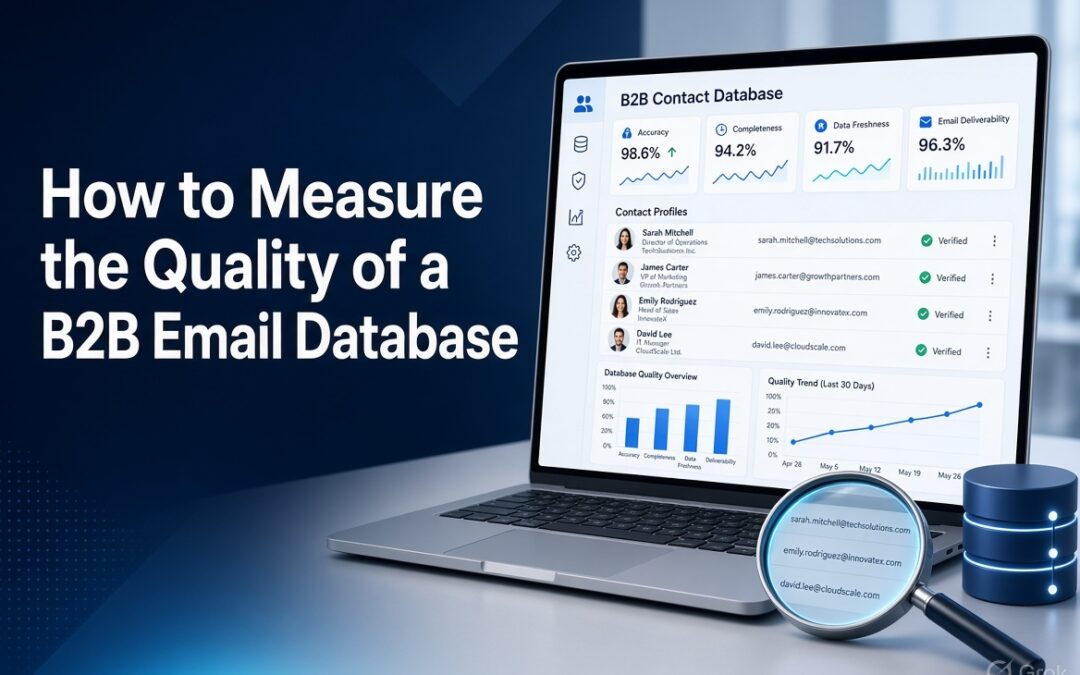
For businesses involved in B2B marketing, having access to accurate professional contact information can make prospecting and customer acquisition more efficient. A business email database provides a way to identify companies, reach relevant professionals, and introduce products or services to potential buyers. However, the usefulness of such a resource depends on the reliability of the information it contains.
A database with thousands of entries may still deliver poor results if the contacts are outdated, incorrectly categorized, or unrelated to your business. Therefore, understanding how to measure the quality of a B2B email database is essential before investing in one or using it for marketing activities. The following factors can help businesses assess database performance and make better decisions.
1. Examine the Reliability of Email Contacts
Start by checking whether the email addresses in the database are genuine, correctly formatted, and associated with the intended businesses. Incorrect addresses can cause delivery failures and create problems for your email marketing campaigns.
A useful evaluation should identify:
-
Addresses containing formatting errors
-
Nonexistent or inactive email accounts
-
Repeated entries belonging to the same contact
-
Business emails that are no longer in use
-
Addresses with uncertain verification results
Consider testing a representative sample through an established email validation service. This provides an initial understanding of the database’s condition before you use it on a larger scale.
2. Find Out How Recently Information Was Updated
Professional contact details do not remain the same indefinitely. People change employers, receive promotions, move into different departments, or leave organizations. Company information can also change following mergers, expansions, or restructuring.
Ask the database provider about its information collection and updating schedule. Determine whether it periodically reviews professional details or simply distributes records collected several years ago.
Important details to examine include current employment, job designations, company websites, business addresses, and industry classifications.
The more recently the information has been reviewed, the more useful it may be for identifying relevant business prospects.
3. Determine Whether Contacts Match Your Audience
Having accurate information is only part of the evaluation process. The people included in the database must also be relevant to the products or services your company offers.
Begin by defining your ideal customer profile. Consider the industries you serve, the organizations you want to approach, and the professional roles involved in purchasing decisions.
For instance, a business offering cybersecurity solutions might focus on IT managers, information security directors, technology heads, and chief information officers.
Check whether the database supports filtering through:
-
Business sectors and industry categories
-
Professional designations and departments
-
Management levels and seniority
-
Organization size and employee strength
-
Countries, states, and regional markets
-
Relevant purchasing and decision-making roles
A well-matched audience provides a stronger foundation for targeted B2B communication.
4. Track Undelivered Emails
Email delivery performance offers practical information about the condition of a contact database. One useful measurement is the bounce rate, which indicates how many messages fail to reach their intended recipients.
There are two primary bounce categories:
Permanent bounce: This happens when an email address is invalid, no longer exists, or cannot receive messages permanently.
Temporary bounce: This occurs when delivery is interrupted by temporary conditions, such as server problems or a recipient’s full mailbox.
Pay particular attention to permanent delivery failures. A growing number of hard bounces may suggest that contact records require cleaning or updating.
Review results across multiple campaigns to identify recurring problems instead of relying on one campaign’s performance.
5. Review the Amount of Information Available Per Contact
A useful business database should provide enough information to help sales and marketing professionals understand whom they are contacting.
Apart from an email address, evaluate whether the records contain relevant business details such as:
-
First and last name
-
Current professional position
-
Department or functional area
-
Organization name
-
Company website
-
Industry information
-
Business location
-
Employee count or company size
Check how many entries contain the fields your team actually needs. Missing information can make prospect classification difficult and increase the time required for manual research.
6. Evaluate Audience Filtering Capabilities
Database segmentation makes it easier to separate potential customers into groups with similar business characteristics.
For example, a marketing agency serving healthcare organizations may need contacts from hospitals, medical technology companies, pharmaceutical businesses, and healthcare service providers.
Check whether the provider allows you to organize records using industry, professional role, company size, location, revenue range, and department.
Flexible filtering can help businesses prepare focused prospect lists instead of approaching unrelated organizations with the same marketing message.
7. Understand How Email Addresses Are Validated
Do not assume that every provider follows an identical email verification process. Different services use different techniques to assess whether an address is likely to receive messages.
Ask whether the provider performs:
-
Email format and syntax inspections
-
Domain availability checks
-
Mail server verification
-
Duplicate record identification
-
Detection of potentially risky addresses
You should also ask how catch-all domains and addresses with uncertain results are classified. These records may not provide a clear indication of whether an individual mailbox exists.
Remember that verification indicates potential deliverability, not guaranteed inbox placement.
8. Measure Responses and Campaign Performance
Once a database is used in a campaign, its usefulness can be evaluated through several performance indicators.
Click-through rate: Shows how frequently recipients click links included in your messages.
Response rate: Measures how many recipients send a reply.
Conversion rate: Identifies the percentage of recipients who complete a desired activity, such as requesting a demonstration or submitting an inquiry.
Open rate: Estimates how frequently delivered messages are opened, although privacy protection technologies can make this measurement less reliable.
These measurements should be interpreted carefully because subject lines, message relevance, sending frequency, and campaign timing also influence results.
9. Investigate Privacy Standards and Information Sources
A professional database should have transparent information about how its records are collected, maintained, and provided to customers.
Before using purchased contacts, review the provider’s privacy documentation, data sourcing methods, and processes for managing opt-out requests.
Businesses should also understand the marketing regulations relevant to their target markets. For example, US email campaigns must consider the CAN-SPAM Act, while applicable European campaigns may fall under GDPR requirements.
Buying a database does not automatically give a business permission to contact every listed individual. Check the legal requirements and establish an appropriate basis for each campaign.
Conclusion
A dependable B2B email database should offer more than an impressive contact count. Its actual value comes from accurate email addresses, current professional information, relevant audience targeting, complete business records, and transparent data practices.
Businesses should regularly review delivery results, validate contact details, and monitor campaign engagement to identify areas that need improvement. Taking these steps makes it easier to select and maintain a database that supports meaningful prospecting, organized sales activities, and long-term B2B marketing objectives.