
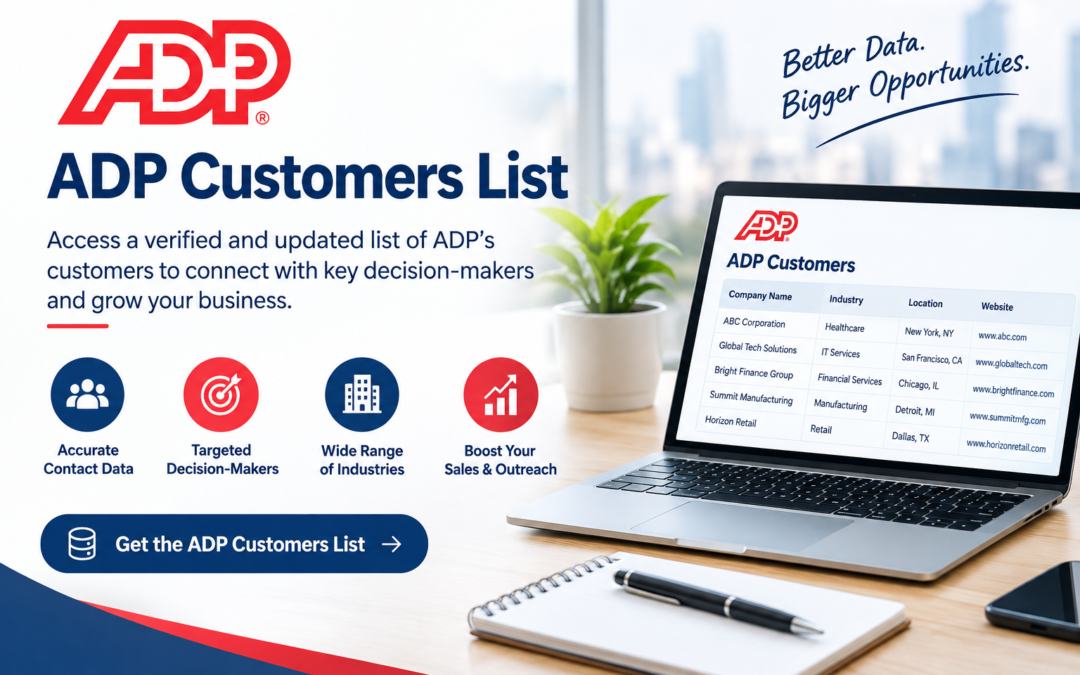
In today’s competitive B2B environment, reaching the right businesses and decision-makers is essential for generating qualified leads. Companies offering payroll services, HR technology, employee management software, accounting solutions, insurance, recruitment services, and other business products often need accurate prospect data to identify potential customers.
An ADP Customers List can be useful for businesses that want to research organizations associated with ADP and develop targeted B2B marketing campaigns. When combined with proper segmentation, personalization, and data verification, customer and prospect intelligence can help marketing teams build more focused outreach strategies.
What Is an ADP Customers List?
An ADP Customers List is a business database containing information about organizations that use or are associated with ADP’s business services. ADP is widely known for providing payroll, human capital management, workforce management, tax, and related business solutions.
Depending on the source and purpose of the database, information may include company names, industries, business locations, employee ranges, technology information, job titles, and professional contact details.
For marketers, this type of data can provide a starting point for understanding businesses that may have specific operational requirements related to payroll, HR, workforce management, employee benefits, compliance, or business administration.
However, businesses should always ensure that any contact data they use has been collected and processed lawfully and is appropriate for their intended marketing activities.
Why Businesses Use Customer and Company Lists
B2B marketing becomes more efficient when companies understand who they want to reach. Instead of communicating with a broad audience, marketers can define specific characteristics and create campaigns around them.
An ADP-related customer or company database can potentially help businesses:
- Identify organizations within selected industries
- Research companies using particular business technologies
- Develop account-based marketing campaigns
- Segment prospects by company size
- Identify relevant departments and job functions
- Build targeted email marketing campaigns
- Support sales prospecting activities
- Improve market research
- Discover potential partnership opportunities
The value of a database depends heavily on its accuracy, freshness, coverage, and legal compliance.
Industries That May Benefit From This Data
Different businesses can use company intelligence for different marketing purposes. Organizations selling products or services to employers may find information about companies using payroll and workforce technologies particularly useful for market research.
Potential industries include:
HR Technology
HR software providers can use company research to identify organizations that may have workforce-related technology requirements. Marketing teams can segment accounts according to employee size, industry, location, or other relevant business characteristics.
Accounting and Finance
Accounting firms, financial technology providers, and business finance companies may use company data to identify organizations that require payroll-related accounting, reporting, or financial services.
Employee Benefits
Insurance providers, benefits consultants, and employee wellness companies may research organizations to understand their potential business audience.
Recruitment Services
Recruitment agencies can use B2B company intelligence to identify organizations that may have hiring requirements. Combining company information with job-function targeting can make prospecting more focused.
Business Software Providers
SaaS companies offering complementary business solutions can research potential accounts and develop targeted account-based marketing campaigns.
How to Segment an ADP Customers List
Simply having a large database does not guarantee successful marketing. Segmentation can make the information more useful by dividing businesses into meaningful groups.
Industry
Start by separating companies according to their industry. A marketing message designed for a technology company may not be suitable for a healthcare organization or manufacturing business.
Company Size
Employee count is another useful segmentation factor. Small businesses, mid-sized organizations, and large enterprises often have different operational requirements and purchasing processes.
Location
Geographic segmentation allows businesses to create campaigns for specific countries, states, cities, or regions. This can be particularly helpful for companies that provide location-specific services.
Job Function
Marketing teams can also concentrate on relevant departments such as human resources, finance, operations, administration, or executive management.
Business Requirements
If enough information is available, companies can create segments based on technology needs, business services, or operational requirements.
Benefits of Targeted B2B Marketing
A well-researched company database can support various aspects of B2B marketing.
Better Audience Targeting
Rather than sending the same message to all businesses, marketers can develop campaigns tailored to specific groups.
This approach makes communication more relevant and effective.
More Personalized Outreach
Understanding a prospect’s industry, company size, role, or business environment enables marketers to craft messages that address relevant challenges and concerns.
Improved Sales Research
Sales teams can save time by not having to search for basic company details, allowing them to focus more on preparing for productive and meaningful conversations.
Account-Based Marketing
ABM directs marketing and sales efforts towards selected organizations.
Company databases can assist teams in identifying and organizing these target accounts.
Market Analysis
Company information can also support broader research into industries, geographic markets, and potential business opportunities.
Data Accuracy Is Important
One of the biggest challenges with B2B databases is data quality. Businesses change their contact details, employees move between organizations, companies merge, and job responsibilities change.
For this reason, marketers should verify information before using it in campaigns.
Important data-quality checks may include:
- Validating business email addresses
- Removing duplicate records
- Checking company information
- Updating job titles
- Removing inactive contacts
- Confirming geographic information
- Reviewing outdated records
- Maintaining suppression and opt-out lists
A smaller database containing accurate and relevant information can be more useful than a very large database filled with outdated records.
Responsible Use of B2B Contact Data
Businesses should treat contact information responsibly. Before launching an email or telemarketing campaign, marketers should understand the applicable privacy and marketing regulations in the regions where their prospects are located.
Organizations should also respect unsubscribe requests and maintain appropriate suppression lists.
Rather than focusing only on the size of an ADP Customers List, businesses should evaluate how the data was collected, whether its use is permitted, how recently it was verified, and whether it fits the intended campaign.
Responsible data practices can help businesses build sustainable marketing processes and protect their reputation.
How Sales Teams Can Use the Data
Sales professionals can incorporate company intelligence into their prospecting workflow.
First, the team can define an ideal customer profile. This may include industry, company size, geographic location, and relevant business requirements.
Next, marketers or sales representatives can identify suitable accounts and research the organization before making contact.
The information can then be used to prepare personalized outreach. Instead of sending a generic sales message, representatives can focus on the prospect’s likely business environment and explain how their solution may address a relevant need.
Finally, responses should be recorded in the company’s CRM so future interactions can be managed effectively.
Combining Customer Data With Other Marketing Channels
An ADP-related company database does not need to be used only for email campaigns. It can support a broader B2B marketing strategy.
For example, marketers can combine account research with:
- LinkedIn outreach
- Content marketing
- Search engine optimization
- Paid advertising
- Webinar campaigns
- Industry-specific landing pages
- Retargeting campaigns
- Sales outreach
- Account-based marketing
The objective should be to create a consistent customer journey rather than relying on one communication channel.
Measuring Campaign Performance
Once a targeted campaign is launched, marketers should monitor measurable results.
Useful metrics can include:
- Email delivery rate
- Open rate
- Click-through rate
- Response rate
- Qualified leads
- Meetings generated
- Conversion rate
- Cost per lead
- Revenue generated
These metrics help teams understand whether their audience targeting and messaging are producing useful business outcomes.
Final Thoughts
An ADP Customers List can serve as a valuable research and prospecting resource for businesses that sell products or services to organizations with payroll, HR, workforce, finance, and employee-management requirements.
However, the effectiveness of any B2B database depends on more than the number of records it contains. Accuracy, segmentation, relevance, verification, personalization, and responsible data practices all play an important role.
Businesses can get greater value from company intelligence by defining their ideal customer profile, organizing prospects into meaningful segments, creating relevant messaging, and measuring campaign performance. When used as one part of a broader marketing and sales strategy, targeted business data can help organizations make their outreach more focused and organized.