
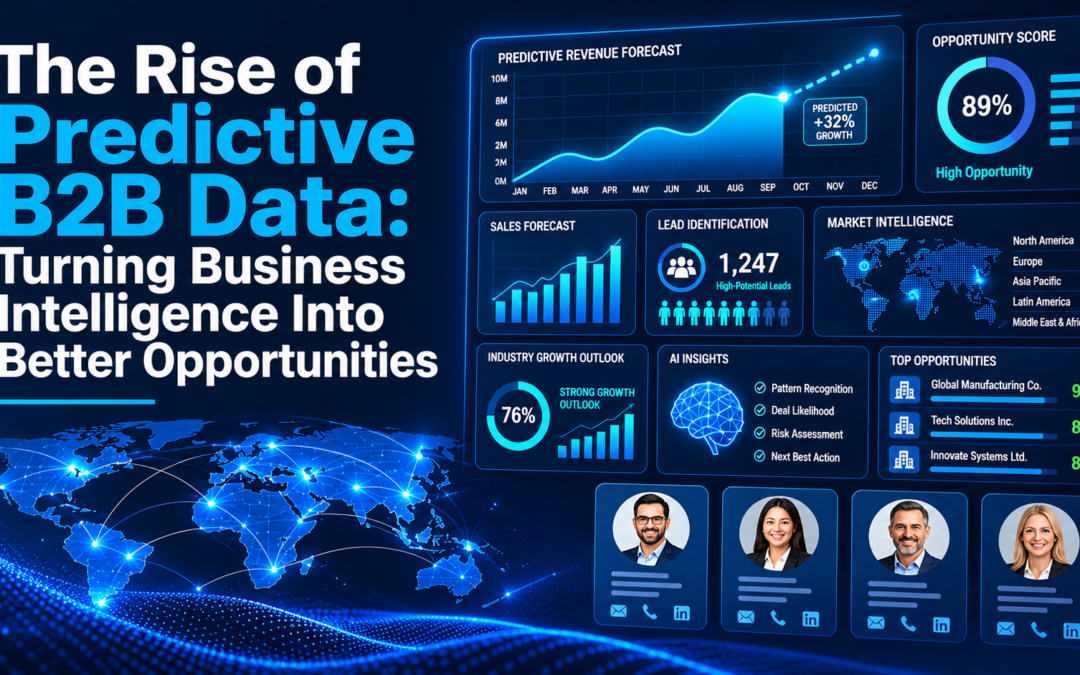
Business-to-business (B2B) companies generate and collect large amounts of information through sales activities, customer interactions, marketing campaigns, and market research. However, simply having access to business data does not guarantee better results. Organizations need ways to interpret that information and identify opportunities before they become obvious. This is where predictive B2B data is becoming increasingly valuable.
Predictive B2B data combines existing business information, analytical methods, and forecasting techniques to help companies estimate future customer behavior, identify promising prospects, and make more informed decisions. Instead of relying entirely on past results, businesses can use data-driven insights to plan their next steps with greater confidence.
1. Understanding Predictive B2B Data
Predictive B2B data refers to business information analyzed to identify patterns, trends, and possible future outcomes. It may include company profiles, industry details, purchasing signals, customer engagement records, and historical sales information.
Advanced analytics and machine learning can examine these data points to identify relationships that may not be immediately visible.
For example, a company selling enterprise software may analyze industry, employee growth, technology adoption, and previous customer behavior to identify organizations that could be interested in its solutions.
Predictive insights do not guarantee that a prospect will make a purchase. Instead, they provide additional information that helps sales and marketing teams prioritize their activities.
2. Why Businesses Are Adopting Predictive Data
Traditional prospecting often depends on broad contact lists, manual research, and previous sales experience. Although these methods can be useful, they may not always reveal which prospects are most likely to become customers.
Predictive data offers a more structured approach by helping businesses identify potential opportunities using multiple indicators.
Some important benefits include:
-
Improved prospect identification: Recognize companies that match specific customer characteristics.
-
Better sales prioritization: Focus resources on accounts showing promising business signals.
-
More relevant marketing: Develop campaigns around industry trends and audience requirements.
-
Stronger planning: Use historical patterns to support future sales and marketing decisions.
-
Efficient resource allocation: Reduce time spent pursuing poorly matched prospects.
These advantages can help organizations make better use of their existing business information.
3. Identifying High-Potential Business Prospects
One important application of predictive B2B data is prospect identification. Not every organization within a target industry will have the same requirements, budget, or purchasing readiness.
Predictive analysis can evaluate several characteristics to help identify companies that may represent stronger opportunities.
These characteristics can include company size, industry, location, hiring activity, expansion announcements, technology requirements, and previous interactions with a business.
For example, a cloud service provider may prioritize companies expanding their IT departments or opening new business locations. Such developments could indicate changing technology requirements.
Sales teams can use these insights to organize prospect lists and focus their research on accounts with relevant business characteristics.
4. Improving Lead Scoring and Qualification
Lead scoring helps businesses rank prospects according to how closely they match their target audience and how much interest they demonstrate.
Predictive analytics can make this process more detailed by evaluating multiple data points rather than relying on a small number of predefined conditions.
For instance, a prospect may receive a stronger score when the company matches the ideal customer profile, operates in a relevant industry, and demonstrates meaningful engagement with marketing content.
Predictive lead scoring can help sales teams distinguish between contacts that are simply present in a database and prospects that deserve further attention.
However, scoring models should be reviewed regularly. Outdated information or poorly selected indicators can produce misleading results.
5. Supporting More Relevant Marketing Campaigns
Predictive insights can also improve how businesses plan and deliver marketing campaigns.
By analyzing audience characteristics and previous engagement, marketers can identify topics, services, and communication approaches that may be relevant to different customer groups.
For example, a business offering financial technology solutions could develop separate campaigns for banks, insurance providers, and payment companies. Predictive insights may help determine which organizations are more likely to require particular services.
This approach supports audience segmentation, personalized messaging, and more focused campaign planning.
Rather than sending identical messages to every contact, businesses can create communication strategies based on relevant company information and potential requirements.
6. The Role of Data Quality in Predictive Analytics
Predictive models are only as dependable as the information used to develop them. Inaccurate company records, outdated job titles, duplicate contacts, and missing information can reduce the usefulness of analytical results.
For this reason, organizations should establish strong data management practices before relying heavily on predictive insights.
Important practices include:
-
Regularly reviewing company and contact records.
-
Verifying professional email addresses.
-
Removing duplicate and irrelevant entries.
-
Updating company details and job information.
-
Maintaining consistent CRM records.
-
Checking the reliability and permitted use of data sources.
Clean and relevant information provides a stronger foundation for meaningful analysis.
7. Challenges Businesses Should Consider
Although predictive B2B data offers several advantages, its implementation requires careful planning.
One challenge is data availability. Some businesses may not have enough reliable historical information to develop useful predictive models.
Another concern is accuracy. Predictive systems identify possibilities based on available patterns, but market conditions, customer priorities, and purchasing decisions can change unexpectedly.
Organizations should also consider privacy requirements, data sourcing, transparency, and responsible use of personal information. Regulations such as GDPR may apply depending on the individuals, organizations, and markets involved.
Human judgment remains important. Predictive insights should support business decisions rather than replace conversations, research, and professional experience.
8. How to Make Predictive B2B Data More Useful
Businesses can begin by identifying a clear objective, such as improving lead qualification, prioritizing accounts, or identifying expansion opportunities.
Next, they should review the quality of their existing CRM and marketing information. Relevant company attributes and consistent records can improve the usefulness of analytical tools.
Organizations should also choose predictive solutions that fit their business requirements, integrate with existing systems, and provide understandable insights.
Finally, teams should compare predictions with actual outcomes. Regular evaluation helps identify inaccurate assumptions and improve future decision-making.
Conclusion
The rise of predictive B2B data represents a shift from simply collecting business information to using it for forward-looking decisions. By combining reliable company records, customer insights, and analytical techniques, organizations can identify promising prospects, improve lead qualification, and plan more relevant marketing activities.
Predictive analytics cannot eliminate uncertainty or guarantee sales results. However, when supported by accurate information and human expertise, it can turn business intelligence into more meaningful opportunities and help companies build stronger, data-driven growth strategies.